Most brands should start on Amazon and add TikTok Shop second. Amazon captures shoppers who already know what they want. TikTok Shop creates demand through creator videos.
Lead with TikTok Shop only in three cases. The product demos well on camera. It sells for about $15 to $75. You can fund creator samples every month.
Brands ask this question because both channels now matter. Both also changed in 2026. TikTok Shop’s US sales roughly doubled in the first half of the year, according to Momentum Works. Its referral fee reportedly rose in August. Amazon held US referral fees flat and raised FBA fulfillment fees by about $0.08 per unit.
The two channels reward different work. Amazon rewards listings, reviews, and ad management. TikTok Shop rewards creators, video, and speed. This guide compares them on shoppers, costs, content, fulfillment, risk, and measurement. It ends with a 90-day plan.
What is the core difference between TikTok Shop and Amazon?
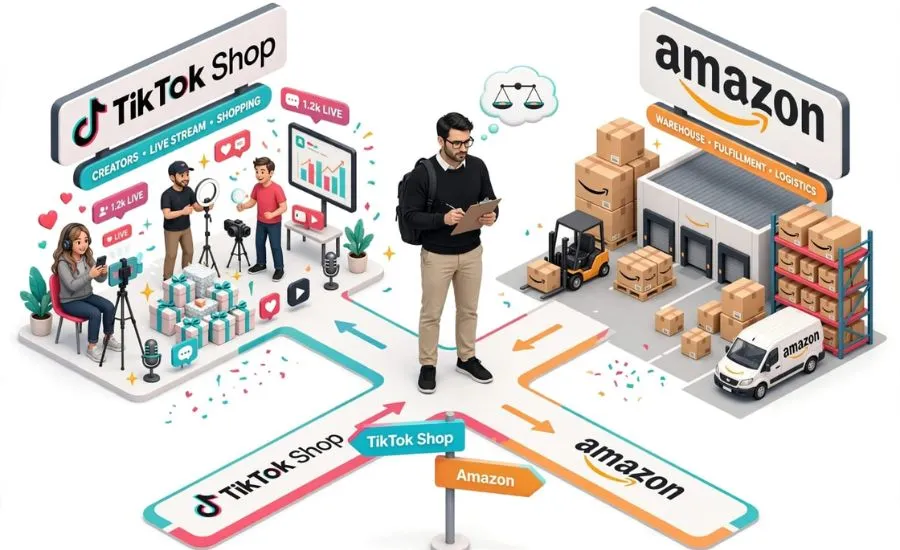
Amazon works like a search engine with a checkout. A shopper types a need, compares reviews, and buys. TikTok Shop works like an entertainment feed with a checkout. A shopper scrolls, watches a creator use a product, and buys on impulse.
That one difference shapes the rest. It decides who buys, which content you need, and how you measure results. It also decides where your money goes.
Think of Amazon as demand capture. Think of TikTok Shop as demand creation. A brand with a proven product and a small audience can use TikTok Shop to find buyers. A brand with attention already can use Amazon to turn it into steady orders.
TikTok Shop vs Amazon at a glance
| Factor | Amazon | TikTok Shop |
|---|---|---|
| How shoppers find products | Search, sponsored ads, product pages | Creator videos, LIVE streams, the For You feed |
| Buyer mindset | Intent, comparison, reviews | Discovery, impulse, trust in the creator |
| Main content | Images, A+ Content, reviews | Short vertical video and LIVE selling |
| Platform fee | Often 15%, lower in some categories | 6% listed, 8% reported for most non-food since August 4, 2026 |
| Other costs | FBA fees, storage, PPC, $39.99 monthly plan | Creator commissions, samples, ads, shipping |
| Fulfillment | FBA with Prime eligibility | Fulfilled by TikTok or your own shipping |
| Repeat purchases | Strong | Weaker |
| Sales pattern | Steady once ranked | Spiky and video driven |
Use the table as a quick screen, not a verdict. The sections below explain each row.
How do shoppers behave on each platform?
Amazon shoppers arrive with a job to do. They search for a product or a problem. They filter by Prime, scan ratings, and buy. They value fast delivery and easy returns. That suits replenishment items, technical products, and anything people research first.
TikTok Shop shoppers did not plan to buy. They opened the app for entertainment. A demo, a story, or a creator they trust moves them to checkout. The audience skews younger, though it keeps widening.
Age is a weak filter. A better test is how people find your product today. If they search for it by name or category, Amazon is your base. If they only want it after watching it work, TikTok Shop can create that moment.
Behavior after the sale also differs. Most TikTok buyers are first-time customers. Amazon supports reorders and Subscribe & Save, so repeat rates run higher.
What does it cost to sell on each channel?
Platform fees
Fee pages online disagree, so check the date on every source. Older guides list TikTok transaction fees between 1.8% and 3.78%. Those numbers are outdated for US sellers. TikTok’s public category table lists 6% for most categories. Several seller reports say the rate for most non-food categories rose to 8% on August 4, 2026. Public documentation had not caught up when we checked. Confirm your exact rate in Seller Center before you model margins.
Amazon kept US referral fees unchanged for 2026. Many categories pay 15%, and some pay less. FBA fulfillment fees rose about $0.08 per unit on average from January 15. The Professional plan costs $39.99 per month.
The platform fee is only part of the bill. TikTok Shop adds creator commissions. The US average sits near 13%, and most rates fall between 10% and 25%. TikTok also charges a refund administration fee. It equals 20% of the referral fee, capped at $5 per SKU. Amazon adds PPC spend, storage fees, and inbound placement fees.
A worked margin example
Take a $30 product with an $8 landed cost. These figures are illustrative. Replace them with your own numbers.
| Line item | Amazon | TikTok Shop |
|---|---|---|
| Sale price | $30.00 | $30.00 |
| Landed cost | -$8.00 | -$8.00 |
| Referral fee | -$4.50 (15%) | -$2.40 (8%) |
| Fulfillment or shipping | -$3.50 (FBA) | -$4.50 (own shipping) |
| Ads or creator commission | -$3.60 (12% ad spend) | -$4.50 (15% affiliate) |
| Samples and content | $0.00 | -$1.80 (6%) |
| Returns allowance | -$0.90 (3%) | -$1.50 (5%) |
| Contribution per unit | $9.50 (31.7%) | $7.30 (24.3%) |
On these assumptions, Amazon leaves about $2.20 more per unit. If TikTok’s rate stays at 6%, the gap shrinks to $1.60. Change the creator rate or the return rate, and the result can flip.
The lesson is simple. A lower platform fee does not mean a lower cost per sale. Build a contribution margin model for each channel before you move budget.
What content does each channel need?
Amazon rewards assets you refine over time. That means a clean main image, benefit-led bullets, and A+ Content. Complete listings also help Amazon’s shopping assistant understand your product. Our post on how Amazon’s AI search picks products explains the signals. If your visuals need work, see how A+ Content design lifts conversion.
TikTok Shop needs a content engine that never stops. New videos must go live every week. Most come from creators, not an in-house studio. When videos stop, sales slow within days. Budget for samples, postage, and follow-up with each creator.
Content can move between channels. Your Amazon photos and copy become creator briefs. Strong creator videos can return as Amazon listing videos, with permission. This cuts production cost on both sides.
How do fulfillment and returns compare?
Fulfillment by Amazon stores, ships, and handles returns for you. Your offer earns the Prime badge. The trade-off is fees and less control over the unboxing.
TikTok Shop gives you more choices. Fulfilled by TikTok exists, but its network is less developed than FBA. Many brands ship from their own warehouse or a third-party logistics partner. TikTok enforces handling times and penalizes late shipments.
Viral spikes are the real operating risk. One video can bring hundreds of orders in hours. If stock runs out, ratings fall. Keep one inventory pool that feeds every channel. This post on shipping from one stock across channels shows the setup. For forecasting, read about planning Amazon inventory.
Returns also differ. Impulse purchases come back more often. A common rule of thumb treats a refund rate above 5% as a product or video problem. Check the claims in each video before you scale it.
How does advertising work on each channel?
Amazon ads run on search intent. Sponsored Products, Sponsored Brands, and Sponsored Display reach active shoppers. Amazon DSP reaches buyers off Amazon. Efficiency depends on campaign structure and keyword discipline. This guide shows where PPC budgets leak.
TikTok ads run on content. Spark Ads boost an existing creator post. Video Shopping Ads and LIVE Shopping Ads push products into the feed. Brands that rely on ads alone rarely see strong returns early. Paid spend works best after a creator video proves itself.
The rule is easy to remember. On Amazon, ads buy position in search results. On TikTok, ads amplify content that already sells.
Who controls the brand, the price, and the customer?
Amazon gives brand owners real tools. Brand Registry opens A+ Content, Brand Stores, and reporting. It also helps you act on counterfeit listings. Our walkthrough on building brand strength through Registry covers setup. Resellers remain the larger risk. See how rogue sellers hurt brands for what to watch.
On TikTok Shop, you control the message but not the delivery. Creators speak in their own voice. Health claims and before-and-after content can break policy. A serious violation can put the shop at risk.
Neither channel hands you the customer list. Plan to collect email and SMS consent through packaging inserts and your own site. Here is why owning customer data matters.
Keep prices aligned across channels. If a TikTok promotion undercuts your Amazon price, shoppers notice. Retail partners notice too.
How risky is TikTok Shop in 2026?
TikTok Shop changes its rules often. On January 22, 2026, TikTok’s US operations moved into a majority American-owned joint venture. Selling continued for most sellers. Early in the year, a long outage cut sales and ad results for some brands. In February, TikTok halted a plan to end independent seller shipping after backlash. In August, the reported fee increase followed.
Scale matters too. Momentum Works estimates 1.35 million US stores in the first half of 2026, nearly triple the year before. More stores mean more competition for creators and attention.
None of this is a reason to skip the channel. It is a reason not to depend on it alone. Keep creator relationships, content files, and audience data portable.
Amazon carries its own risks. Suspensions and listing suppression happen. Still, Amazon announces fee changes on a published schedule, which makes planning easier.
Which products fit each channel?
| Better on Amazon | Better on TikTok Shop | Works on both |
|---|---|---|
| Products searched by name or category | Products that demo in the first three seconds | Home and kitchen gadgets |
| Replenishment and subscription goods | Clear before-and-after results | Pet products |
| Technical products that need comparison | Impulse prices near $15 to $75 | Wellness items with careful claim review |
| Commodity items decided by reviews and price | Beauty, personal care, and accessories | Food and drink with a story |
Products above roughly $150 struggle on TikTok Shop without a strong creator hook. Supplements and medical devices face strict claim rules.
Should brands sell on both?
For most brands, yes, in a set order. The channels feed each other. TikTok drives discovery and the first purchase. Amazon captures search demand and repeat orders. One agency reports an 18% to 35% lift in Amazon sales for brands running creator programs. Treat that as a claim to test, not a promise.
A halo also protects you. People who see a product on TikTok often search for it on Amazon. If your listing is weak or missing, a reseller or copycat takes that sale.
How to measure the halo
TikTok’s own reports undercount its impact, because many viewers buy elsewhere. Compare the four weeks of a creator push against the four weeks before. Track four signals:
- Branded search volume in Brand Analytics.
- Best Sellers Rank on the featured products.
- Organic rank on your main non-branded keywords.
- Subscribe & Save adoption.
If TikTok sales rise and Amazon stays flat, buyers are not returning. Check price, bundles, and the listing. Outside traffic can also lift organic rank. Our guide to sending outside traffic to a listing explains how.
Where to start
- New brand, searched product: Start on Amazon. Build reviews and rank first.
- New brand, visual impulse product: Run both, with a small TikTok test.
- Already on Amazon: Add TikTok Shop with three to five hero products.
- Already on TikTok Shop: Get on Amazon fast. Buyers will search for you.
- Manufacturer or retail-first brand: Protect Amazon pricing and Brand Registry first. Test TikTok Shop second.
A 90-day plan for adding the second channel
- Days 1 to 30, fix the base. Audit listings, pricing, inventory, and brand protection on your first channel. Model contribution margin for each SKU.
- Days 31 to 60, seed the test. Pick three to five hero products with strong demos. Send samples to creators who fit the niche. Set affiliate rates you can afford.
- Days 61 to 90, boost and measure. Put ad spend behind videos that convert. Track Amazon halo metrics weekly. Pause any product with a refund rate above 5%.
FAQs
Is TikTok Shop better than Amazon?
Neither wins in every case. Amazon is stronger for products people search for and reorder. TikTok Shop is stronger for visual, impulse-priced products that demo well. Most brands do best running both, with Amazon as the base.
Is it cheaper to sell on TikTok Shop than Amazon?
The platform fee is usually lower on TikTok Shop, even after the reported 8% rate. Creator commissions, samples, and content then close much of the gap. Compare contribution margin per channel instead of headline fees.
Does TikTok Shop help Amazon sales?
Often it does. Viewers search for products they saw on TikTok. That lifts branded search, rank, and Best Sellers Rank. Measure the lift by comparing Amazon metrics before and during a creator push.
Should a new brand start on TikTok Shop or Amazon?
Most new brands should start on Amazon. It builds reviews, rank, and repeat buyers. Start on TikTok Shop first only if the product is visual and impulse-priced. Be ready to capture the demand on Amazon too.
Can I use the same inventory for both channels?
Yes, with care. Brands pair Fulfilled by TikTok with FBA, or ship both from one third-party warehouse. Sync stock across channels so a viral spike does not oversell.
Final take
Amazon is your search engine. TikTok Shop is your discovery engine. Brands that treat them as partners, with shared content, shared stock, and aligned pricing, get more from each.
If you want help running both from one plan, see how our team handles Amazon growth work and day-to-day TikTok Shop work.